

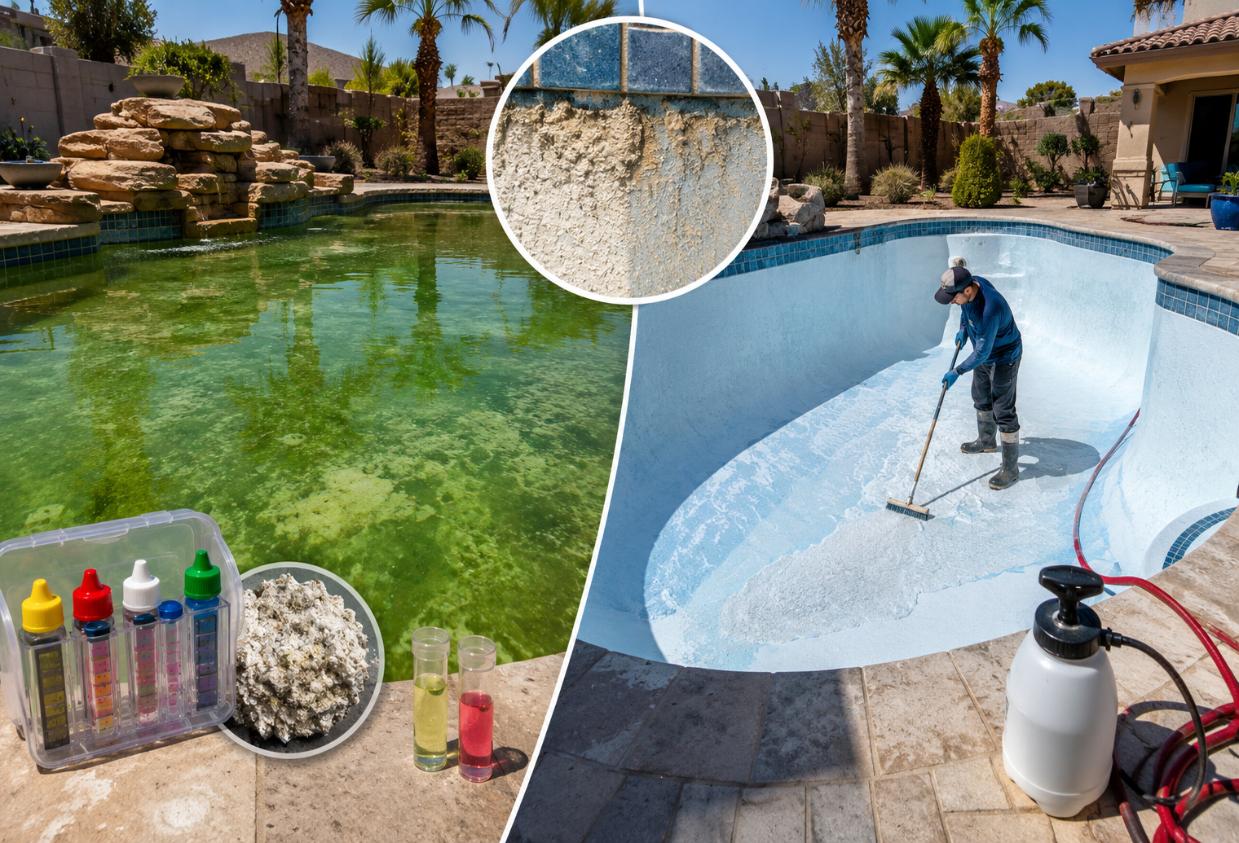
A Chandler swimming pool can look clear and still have a water chemistry problem building below the surface. Between intense summer evaporation, mineral-heavy replacement water, dust, and months of chemical additions, dissolved material can accumulate while calcium deposits become increasingly visible on tile, plaster, and other pool surfaces.
Quick answer: Draining or acid washing a pool may be appropriate when high total dissolved solids (TDS), excessive calcium buildup, stubborn scaling, or surface staining cannot be adequately corrected through normal water treatment. Draining replaces concentrated pool water with fresh water, while an acid wash is a more aggressive surface treatment generally reserved for certain plaster or similar finishes. These are different procedures, and not every pool that needs fresh water needs an acid wash.
What local pool owners should know
-
Persistent scaling around the waterline can indicate a calcium or water-balance problem that routine brushing alone will not solve.
-
Chandler’s hot, dry climate encourages evaporation, leaving dissolved minerals behind as water disappears.
-
Adding replacement water restores the water level, but it does not remove the minerals already concentrated in the pool.
-
An acid wash should not be treated as routine maintenance because it removes a thin layer from compatible pool surfaces.
-
Pool draining requires careful planning in the East Valley because extreme heat, pool construction, groundwater conditions, and the condition of the finish can affect how the job should be handled.
Why Does High TDS and Calcium Matter in Chandler Pools?
High TDS and calcium matter in Chandler because evaporation can steadily concentrate dissolved material in pool water, contributing to difficult water balance, scale, cloudy conditions, and deposits on pool surfaces and equipment. Repeatedly topping off an evaporating pool can compound the problem because minerals remain behind when water evaporates.
This cycle is especially relevant during long stretches of triple-digit heat across the Southeast Valley. Pool water disappears, fresh water is added, and dissolved material can accumulate over time.
Hard, crusty deposits may become noticeable along the waterline, spillways, raised features, or areas where water repeatedly evaporates. Dust from dry weather and monsoon activity can create additional maintenance demands.
SolWater Pools helps local pool owners determine whether water chemistry can still be corrected through routine treatment or whether partial or complete water replacement and surface treatment should be considered. From this point forward, we focus on matching the service to the actual condition of the water and pool surface rather than treating draining or acid washing as automatic solutions.
What Do Local Water Conditions Tell Pool Owners?
Local water conditions tell pool owners that mineral management deserves ongoing attention because Arizona’s water is generally considered hard, and evaporation can further concentrate minerals inside a swimming pool. The actual chemistry of an individual pool still needs to be tested before deciding that TDS or calcium is the cause of a problem.
Public water-quality information from the City of Chandler can help residents understand their source water, but a pool is its own changing chemical environment. Sunlight, evaporation, sanitizers, fill water, debris, and other treatments all affect what eventually happens inside the vessel.
Our field approach is therefore based on testing the pool itself and inspecting its surfaces. A visible white line does not, by itself, prove that a pool needs to be drained.
How Can High Calcium and TDS Affect Your Pool?
High calcium and accumulated dissolved solids can make pool care more difficult by contributing to scale, deposits, surface problems, and water that becomes harder to keep properly balanced. For Chandler homeowners, these conditions can become especially noticeable after repeated cycles of summer evaporation and refilling.
Calcium scale can affect more than appearance. Deposits may form around tile, water features, fittings, or equipment where mineral-rich water repeatedly passes or evaporates.
Water chemistry also works as a system. Calcium hardness, pH, total alkalinity, temperature, and other factors influence whether water tends toward scaling or other balance problems. That is why one test result should not be used in isolation to diagnose the entire pool.
What Are the Warning Signs That Your Pool May Need Attention?
The clearest warning signs are persistent calcium scale, recurring cloudy water, stubborn surface discoloration, difficult-to-manage chemistry, and deposits that quickly return after cleaning. These signs do not automatically mean an acid wash or complete drain is necessary, but they justify a closer water and surface evaluation.
Watch for:
-
A rough or chalky white line developing around the waterline.
-
White deposits accumulating on tile, spillways, fittings, or decorative features.
-
Pool surfaces that feel noticeably rougher because of mineral deposits.
-
Cloudiness that repeatedly returns despite appropriate filtration and chemical adjustment.
-
Water chemistry that becomes increasingly difficult to maintain.
-
Significant staining or discoloration on a compatible plaster-type surface.
-
Calcium deposits that return soon after ordinary brushing or cleaning.
-
Test results showing elevated dissolved solids or calcium combined with other signs of scaling.
In neighborhoods from Ocotillo and Fulton Ranch to Sun Lakes and South Chandler, pools experience the same broad desert pressures, but each pool’s history and chemistry can be different.
When Should You Call a Pool Professional?
You should call a pool professional when scaling is widespread, chemistry remains difficult to correct, staining is embedded in the finish, or you are considering draining or acid washing the pool. Routine testing and brushing are reasonable homeowner tasks, but draining and aggressive surface treatment require a more complete evaluation.
A professional can help distinguish between a chemistry problem, removable surface scale, staining, and deterioration of the pool finish.
This distinction matters because an acid wash is not a cure for every water-quality issue. If the primary problem is accumulated dissolved material in the water, replacing water may be more relevant. If the problem is a compatible surface with severe staining, an acid wash might be considered after inspection.
What Commonly Causes TDS and Calcium Problems in Chandler?
The most common local contributors include evaporation, hard replacement water, chemical accumulation, high-pH conditions, and repeated cycles of topping off the pool without removing concentrated water. Chandler’s desert climate makes evaporation one of the most important factors to understand.
-
Heavy evaporation: Water leaves the pool while many dissolved minerals remain behind.
-
Replacement water: Filling the pool restores volume but can introduce additional minerals.
-
Water imbalance: Elevated pH and other chemistry conditions can encourage calcium to form scale rather than remain dissolved.
-
Chemical accumulation: Pool products and other dissolved substances can contribute to TDS over time.
-
Long intervals without water replacement: Depending on water chemistry and maintenance history, dissolved material can become increasingly concentrated.
Monsoon dust and debris add another maintenance challenge across Maricopa County, although they should not automatically be blamed for elevated calcium.
How Can Chandler Pool Owners Reduce Calcium and TDS Problems?
Pool owners can reduce scaling and water-quality problems by testing regularly, maintaining balanced chemistry, brushing developing deposits early, and having the water evaluated before mineral accumulation becomes severe. Preventive attention is particularly valuable during the hottest months, when evaporation and refill cycles accelerate.
Check the waterline regularly for new deposits. Test pH, alkalinity, sanitizer levels, and calcium hardness according to the needs of your pool, and investigate significant changes instead of simply adding more chemicals.
TDS can provide useful context, but it should be interpreted alongside the complete water picture.
DIY maintenance should stop before attempting a full drain or acid treatment without understanding the pool’s construction and condition. Arizona heat can also make timing important when exposing pool surfaces.
What Results Can You Expect From Draining or Acid Washing?
Draining can reduce concentrations of dissolved material by replacing old water, while acid washing can remove certain stains and surface discoloration from compatible finishes. The expected result depends on whether the underlying problem is in the water, on the surface, or both.
Fresh water still needs to be balanced after refilling. An acid-washed pool also requires appropriate startup and chemistry management afterward.
An acid wash will not restore every damaged or aging finish to new condition. Because the process removes a small amount of surface material, it should be recommended selectively rather than used as a routine cosmetic treatment.
What Mistakes Should Pool Owners Avoid?
The biggest mistakes are assuming every white deposit requires an acid wash, draining without evaluating the pool first, and treating one chemistry number as the entire diagnosis. A better approach is to identify whether the problem comes from the water, surface deposits, staining, or an aging finish.
Mistake: Draining solely because TDS appears high.
Consequence: The pool may undergo unnecessary water replacement if the number is not interpreted in context.
Better approach: Review complete water chemistry and pool history.
Mistake: Acid washing every stained pool.
Consequence: An aggressive treatment may be used when cleaning, chemistry correction, or another service is more appropriate.
Better approach: Identify the stain and evaluate the finish first.
Mistake: Ignoring early calcium deposits.
Consequence: Scale may become thicker and more difficult to address.
Better approach: Correct water balance and address deposits while they are manageable.
What Does a Common Local Scenario Look Like?
A common Chandler scenario is a pool that receives frequent top-offs through the hottest part of the year and gradually develops a rough white waterline even though the owner continues normal chemical maintenance. This is an illustrative local scenario, not a SolWater Pools customer case study.
Testing may reveal that calcium and other dissolved material have accumulated while the water’s overall balance favors scaling. The appropriate response might involve chemistry correction, scale treatment, partial water replacement, or more extensive service depending on the test results and finish condition.
The key is diagnosis before treatment.
Which Pool Services Can Address These Problems?
The appropriate service may include professional water testing, chemistry correction, water replacement, calcium-scale treatment, or an acid wash when the pool surface and staining justify it. Not every pool requires every service, so inspection should determine the least aggressive effective approach.
If you’re seeing stubborn scale, discoloration, or recurring water problems, we can evaluate the pool and explain which options make sense.
Is Draining Better Than Acid Washing?
Draining and acid washing solve different problems, so neither option is automatically better. Water replacement addresses excessive concentrations in the water, while an acid wash targets certain staining and discoloration on compatible surfaces and necessarily involves draining the pool as part of the process.
Routine chemistry correction is the least invasive option when the water can still be brought into an appropriate range. Partial water replacement may be considered when reducing dissolved concentrations without replacing all the water is practical.
A full drain may be appropriate in some situations, while acid washing should generally be reserved for conditions where the surface itself warrants that treatment.
Where Does SolWater Pools Serve Around Chandler?
Our local service focus includes Chandler and surrounding East Valley communities where desert heat, hard water, and heavy pool use create demanding maintenance conditions. Pool owners in nearby areas such as Gilbert, Sun Lakes, and other parts of the Southeast Valley can experience similar mineral and evaporation challenges.
Service availability outside the primary area should be confirmed directly with us.
What Can Happen If You Ignore Severe Scale or Water Problems?
Ignoring severe scale or persistently unbalanced water can allow deposits and water-quality problems to become harder to manage over time. In Chandler’s high-evaporation environment, continually adding fill water without addressing an underlying mineral problem may allow the same cycle to continue.
Waiting can mean more difficult cleaning, more persistent deposits, or the need for a more involved corrective service later. Addressing the cause early gives you more options.
FAQ About Draining and Acid Washing Chandler Pools
How do I know if my Chandler pool has high TDS?
Testing is the way to determine whether your pool has elevated TDS. Visual symptoms such as scale or recurring cloudy water can suggest a chemistry issue, but they cannot identify TDS by themselves. A complete water evaluation provides better context by considering dissolved solids alongside calcium hardness, pH, alkalinity, and other relevant chemistry.
Does high TDS mean I automatically need to drain my Chandler pool?
No, a high TDS reading alone does not automatically mean your Chandler pool needs a complete drain. The number should be considered with the water’s chemistry, treatment history, symptoms, and the substances contributing to the dissolved-solids level. Depending on those findings, chemistry correction or partial water replacement may be considered before a complete drain.
Why do Chandler pools get calcium scale?
Chandler pools can develop calcium scale when mineral-rich water and scaling water chemistry combine with intense evaporation. As water evaporates in Arizona’s dry heat, minerals remain in the pool. If calcium hardness, pH, alkalinity, temperature, and related chemistry favor precipitation, calcium can form visible deposits on pool surfaces.
Will an acid wash remove calcium from my pool water?
No, an acid wash is primarily a surface treatment and should not be viewed as a method for correcting calcium concentration in the water. Water replacement can reduce dissolved mineral concentrations, while an acid wash may address certain surface staining or deposits on compatible finishes. The correct treatment depends on where the problem exists.
How often should a pool in Maricopa County be drained?
There is no single drain schedule that is appropriate for every Maricopa County pool. Water chemistry, source water, evaporation, maintenance practices, finish condition, and previous water replacement all affect the decision. Testing the actual pool is more useful than draining automatically according to a fixed calendar.
Is it safe to drain a pool during a Chandler summer?
Pool draining during a Chandler summer requires careful planning because extreme temperatures can expose pool finishes to harsh conditions. The pool’s construction, surface condition, weather, and other site factors should be evaluated before draining. A professional assessment can help determine appropriate timing and reduce avoidable risks during hot weather.
Can I remove Chandler pool calcium scale without draining?
Some calcium deposits may be treatable without completely draining the pool, depending on their severity, location, and the pool surface involved. Early deposits may respond differently from thick, established scale. Correcting the chemistry that contributed to scaling is also important, or cleaned surfaces may develop deposits again.
Is an acid wash good for an older plaster pool?
An acid wash is not automatically appropriate for an older plaster pool because it removes a thin layer of the surface. The existing condition and remaining integrity of the finish should be evaluated first. If the plaster is already deteriorated, another approach may make more sense than using an aggressive treatment for cosmetic improvement.
Get Clear Answers About Your Chandler Pool Water
Mineral buildup is common in the East Valley, but draining or acid washing should follow a diagnosis rather than a guess. We can evaluate the water, visible scale, staining, and pool surface so you understand what needs attention and which treatment is appropriate.
Protect Your Pool From Stubborn Scale and Water Problems
Get a professional evaluation focused on the condition of your pool and realistic treatment options.