

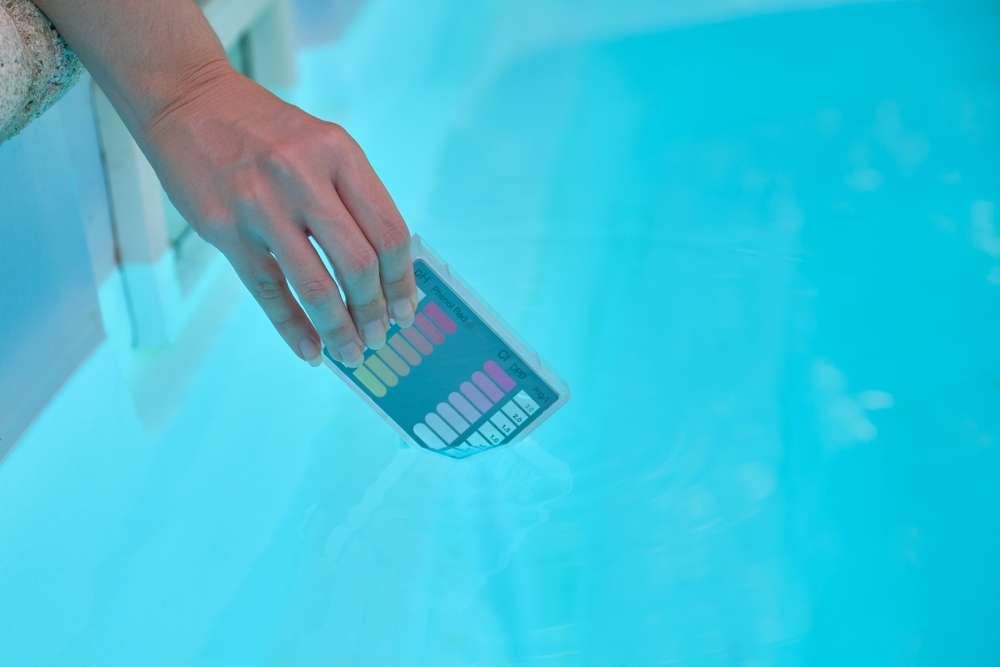
A Chandler pool can look perfectly clear and still become difficult to sanitize during an Arizona summer. Intense sunlight, triple-digit temperatures, evaporation, dust, and repeated chemical additions can push pool chemistry farther out of balance than another scoop of chlorine can correct.
The key is knowing when chlorine simply needs replenishing and when the water itself has accumulated chemistry that needs to be reduced through draining and replacement.
Quick answer: Extreme Arizona heat does not literally make chlorine useless, but it creates conditions that can make maintaining an effective chlorine residual much harder. Strong sunlight increases chlorine loss, warm water can increase sanitizer demand, and repeated use of stabilized chlorine can raise cyanuric acid, or CYA. When CYA or other dissolved material becomes excessively concentrated, adding more chemicals may not correct the underlying water problem. Partial or, in appropriate cases, more extensive pool draining and refilling may be necessary.
What Chandler pool owners should know
-
Arizona sunlight can consume unprotected chlorine quickly, so summer testing needs to account for changing chlorine demand.
-
Stabilizer protects chlorine from sunlight, but excessive CYA can require a higher free-chlorine level to maintain effective sanitation.
-
Chandler’s hard water and heavy evaporation can concentrate calcium and other dissolved minerals over time.
-
Monsoon dust, debris, swimmers, and storms can create additional sanitizer demand during the hottest part of the year.
-
Draining is not automatically the answer to every chlorine problem. It becomes relevant when testing confirms water chemistry that cannot practically be corrected by adding chemicals alone.
Why Does Extreme Arizona Heat Cause So Many Pool Chemistry Problems?
Extreme Arizona heat causes pool chemistry problems because intense sunlight, high water temperatures, evaporation, and increased pool use can all increase the amount of attention a pool needs. Around Chandler and the Southeast Valley, these conditions can persist for weeks at a time instead of appearing as an occasional hot spell.
The National Weather Service issued multiple extreme heat warnings for the Phoenix metropolitan area during August 2026, with forecast highs in parts of the Valley reaching well above 110°F. That is the environment backyard pools in Maricopa County have to operate in.
Sunlight is especially important. Ultraviolet radiation breaks down chlorine that is not adequately protected by cyanuric acid. Meanwhile, swimmers, organic debris, monsoon dust, and warm water can increase sanitizer demand.
A pool in Ocotillo, Fulton Ranch, Sun Lakes, or another part of the Southeast Valley therefore faces a very different summer maintenance environment than a pool in a cooler climate.
At SolWater Pools, we look at the complete water chemistry rather than treating every low-chlorine reading as a signal to simply add more chlorine.
How Can a Pool Have Chlorine but Still Have a Sanitation Problem?
A pool can contain measurable chlorine while still having inadequate sanitation if the chlorine level is not appropriate for the pool’s cyanuric acid level and current demand. That distinction matters because a test showing some free chlorine does not tell the entire story.
Cyanuric acid protects chlorine from rapid UV degradation. Without enough stabilizer, Arizona sunlight can make chlorine difficult to maintain.
But more stabilizer is not always better.
As CYA rises, maintaining appropriate sanitation requires managing free chlorine in relation to that CYA level. Repeatedly adding stabilized chlorine products can contribute additional CYA over time.
This is one reason a homeowner can get stuck in a cycle of adding sanitizer, seeing temporary improvement, and then fighting the same water problem again.
Why Does Chandler’s Water Make the Problem More Complicated?
Chandler’s water can make long-term pool chemistry more challenging because local fill water contains substantial mineral hardness, and evaporation leaves those minerals behind. The City of Chandler reports that drinking-water hardness varies across the system and averages about 16.5 grains per gallon.
Evaporation removes water from your pool, but calcium and many other dissolved substances do not evaporate with it.
Then you add more Chandler tap water.
The water level returns to normal, but the pool receives another dose of minerals. Repeat that process through multiple East Valley summers and dissolved material can accumulate.
This does not mean local tap water is unsafe. The City of Chandler performs regular drinking-water testing and reports compliance with applicable drinking-water standards. Pool chemistry is a different issue because a swimming pool repeatedly loses water to evaporation while retaining dissolved minerals.
When Is Draining the Pool Actually the Fix?
Draining becomes the practical fix when testing confirms excessive concentrations of substances that cannot simply be chemically removed from the water. High CYA and excessive calcium hardness are two situations in which replacing a calculated portion of the pool water may be considered.
This is an important distinction: heat by itself is not a reason to drain a pool.
If free chlorine is low because the pool simply needs more sanitizer, circulation, cleaning, or corrected chemistry, draining would be unnecessary. If CYA has accumulated beyond the desired operating range, however, adding another chemical does not make that CYA disappear.
Water replacement physically reduces its concentration.
The same basic principle applies to accumulated dissolved minerals. Depending on test results, pool condition, water chemistry, and the severity of the problem, the appropriate response might be a partial drain rather than emptying the entire pool.
What Are the Warning Signs That Your Pool Water Needs More Than Chlorine?
Repeated chlorine problems despite regular chemical additions are a warning that the underlying water chemistry should be tested before more products are added. Chandler pool owners should pay particular attention when several of these symptoms occur together:
-
Free chlorine repeatedly falls faster than expected.
-
Algae returns shortly after treatment.
-
The pool becomes cloudy despite filtration and chemical additions.
-
CYA testing shows an excessive stabilizer concentration.
-
Calcium hardness or total dissolved material has become difficult to manage.
-
Scale appears around the waterline, tile, spillways, or pool equipment.
-
Chemical adjustments produce only temporary improvement.
-
You are adding increasing amounts of sanitizer without resolving the original problem.
These signs do not prove that draining is required. They indicate that comprehensive water testing is a better next step than guessing.
What Are the Most Common Local Causes?
The most common Chandler causes combine intense sun exposure with evaporation, concentrated water chemistry, debris, and maintenance practices. The Arizona climate can magnify small chemistry mistakes over a long swimming season.
1. Intense UV exposure: Strong Arizona sunshine accelerates the loss of inadequately protected chlorine.
2. Excessive stabilizer: Repeated use of stabilized chlorine can gradually increase CYA.
3. Evaporation and refill cycles: Water leaves the pool while minerals remain behind, then additional minerals arrive with refill water.
4. Hard fill water: Chandler’s municipal water hardness makes calcium management particularly relevant for local pools.
5. Monsoon debris: Dust, leaves, organic material, and storm debris can increase the work required from both the sanitizer and filtration system.
6. Heavy summer swimming: More swimmers introduce additional contaminants and increase chlorine demand.
Can You Prevent Chlorine Problems During a Chandler Summer?
You can prevent many summer chlorine problems by testing frequently, managing CYA deliberately, maintaining circulation, and correcting problems before repeated chemical additions create new ones. Prevention is especially valuable from late spring through the hottest months in the Valley.
Check free chlorine and pH regularly, and periodically test the broader chemistry, including CYA and calcium hardness. Keep baskets and filters clean, remove debris promptly, and pay attention to circulation.
After a monsoon storm or unusually heavy pool use, do not assume your normal chemical routine will automatically be sufficient. Test the water and respond to the actual readings.
Most importantly, avoid blindly adding stabilizer or stabilized sanitizer when you do not know the existing CYA level.
What Results Should You Expect After Water Replacement?
Properly calculated water replacement should lower the concentration of accumulated substances in proportion to the amount of old water replaced, although refill-water chemistry also affects the final result. After refilling, the pool still needs to be tested and balanced rather than immediately treated as finished.
Fresh fill water introduces its own calcium, alkalinity, pH, and other characteristics. In Chandler, that means hardness needs to remain part of the equation.
After water replacement, the next steps generally include testing the new water mixture, adjusting chemistry, establishing an appropriate sanitizer level, and monitoring how the pool responds under Arizona sun.
What Mistakes Make Arizona Pool Chemistry Worse?
The biggest mistakes are treating every water problem as a chlorine shortage and making chemical changes without complete test results. In Chandler’s climate, that approach can turn a manageable imbalance into a recurring summer problem.
Mistake: Adding more stabilized chlorine every time free chlorine drops.
Consequence: CYA may continue accumulating.
Better approach: Test CYA and choose sanitizer based on the complete chemistry.
Mistake: Topping off the pool without considering mineral accumulation.
Consequence: Evaporation and refill cycles can steadily concentrate hardness.
Better approach: Monitor calcium hardness and overall water condition over time.
Mistake: Draining solely because it is extremely hot.
Consequence: You may replace thousands of gallons without addressing the actual cause.
Better approach: Confirm through testing that water replacement is necessary.
Mistake: Completely draining a pool without professional guidance.
Consequence: Empty pools can face structural and surface risks, and extreme heat can create additional concerns for exposed finishes.
Better approach: Determine how much water actually needs replacement and use an appropriate draining strategy.
A Common Chandler Pool Scenario
A common local scenario begins with a homeowner noticing that chlorine will no longer hold through the summer. They add more sanitizer, get a better reading temporarily, and then watch it fall again.
The pool may still look reasonably clear, so the owner assumes Arizona heat is simply consuming everything they add.
Testing can reveal a more complicated situation. The pool may have significant CYA accumulation, elevated calcium hardness from years of evaporation and refilling, or an unusually high chlorine demand caused by contamination.
In that situation, buying more chemicals without identifying the underlying cause can prolong the cycle. The correct solution starts with actual test results.
When Should You Call a Pool Professional?
You should call a pool professional when chlorine repeatedly disappears, algae keeps returning, chemistry remains outside manageable ranges, or you are considering draining a significant amount of water. Professional testing can distinguish an ordinary summer chlorine adjustment from a water-quality problem that requires replacement.
We can evaluate the chemistry as a system rather than focusing on a single test result. That helps determine whether the appropriate response is routine balancing, sanitation treatment, filtration or circulation work, partial water replacement, or another corrective step.
How Do Your Pool-Care Options Compare?
Testing and targeted treatment should come before draining because the correct solution depends on what is actually causing the chlorine problem. A low sanitizer reading alone is not enough to justify replacing pool water.
Routine chemical balancing works when the water is fundamentally manageable. More intensive sanitation may be appropriate when organic contamination is creating high chlorine demand. Equipment inspection may be needed when poor circulation or filtration contributes to recurring water problems.
Water replacement becomes relevant when the problem is the concentration of something already dissolved in the water, such as excessive CYA or accumulated minerals.
The goal is not to drain whenever possible. It is to avoid continuing to add chemicals when chemistry shows that replacing some water is the more appropriate corrective step.
What Areas Do We Serve Around Chandler?
We help pool owners in Chandler and surrounding East Valley communities address water chemistry problems created by our demanding desert environment. Local conditions extend beyond city boundaries into nearby Gilbert, Sun Lakes, Mesa, and Queen Creek, where pools face similar summer sun, evaporation, dust, and hard-water challenges.
What Happens If You Keep Ignoring the Problem?
Ignoring chronically unbalanced pool water can mean recurring algae, unreliable sanitation, scaling, cloudy water, and unnecessary chemical use. During a Chandler summer, the problem can become especially frustrating because high temperatures and intense sun leave less room for inconsistent maintenance.
Waiting can also allow mineral accumulation or water-quality issues to become more difficult to manage.
The better approach is to identify why chlorine is not performing as expected and correct that specific condition rather than continuing an endless add-and-test cycle.
FAQ
Does Arizona heat really destroy pool chlorine?
Arizona heat contributes to difficult chlorine management, but sunlight is a major reason outdoor chlorine disappears quickly. UV radiation breaks down chlorine, while warm conditions, swimmers, debris, and contamination can increase sanitizer demand. Proper CYA levels help protect chlorine, which is why the entire chemistry needs to be considered rather than temperature alone.
Why won’t my Chandler pool hold chlorine?
A Chandler pool may not hold chlorine because of strong sunlight, inadequate or excessive CYA, algae or other contaminants, heavy swimmer load, debris, or maintenance and circulation issues. If adding chlorine repeatedly produces the same result, complete water testing can identify whether the problem is sanitizer demand, stabilization, filtration, or accumulated chemistry.
Does high CYA mean I have to drain my pool?
High CYA can require partial water replacement because cyanuric acid cannot normally be corrected simply by adding another balancing chemical. The amount of water that needs replacement depends on the measured CYA concentration and the target level. Test accurately before deciding how much water to replace.
Should I completely drain my pool during a Chandler summer?
A complete drain should not be the automatic response to a Chandler summer chemistry problem. Extreme temperatures can also make draining and leaving pool surfaces exposed a poor DIY project. Determine whether water replacement is needed, how much should be replaced, and how the pool can be handled safely before proceeding.
Does Chandler have hard water?
Yes, Chandler reports hard municipal water, with hardness varying throughout its distribution system and an average of about 16.5 grains per gallon. For pools, repeated evaporation and refilling can concentrate calcium because water evaporates while dissolved minerals remain. That makes long-term calcium monitoring particularly useful for local homeowners.
Can monsoon storms affect my pool chlorine?
Yes, monsoon conditions can change a pool’s sanitizer demand by introducing dust, dirt, leaves, and other organic debris. Around Chandler and the Southeast Valley, cleaning baskets, removing debris, checking filtration, and retesting the water after significant storms can help prevent a temporary disruption from turning into cloudy water or algae.
How often should I test my Chandler pool in extreme heat?
Pools should be tested often enough during extreme heat to catch sanitizer and pH changes before water quality deteriorates. The appropriate frequency depends on the pool, sanitizer system, swimmer load, exposure, and current chemistry. During Chandler’s hottest periods, relying on an old test result for an extended period can leave important changes unnoticed.
Will adding more chlorine fix high stabilizer?
No, adding more chlorine does not remove excessive stabilizer from pool water. While the required chlorine level is related to the CYA concentration, continually adding stabilized products can contribute still more CYA. If testing confirms excessive accumulation, replacing an appropriate portion of the water may be the practical corrective option.
Get Your Chandler Pool Chemistry Back Under Control
Arizona heat makes pool care demanding, but recurring chlorine problems should not be dismissed as something every homeowner simply has to tolerate. Accurate testing can show whether your pool needs routine balancing, better sanitation, equipment attention, or water replacement.
Stop Guessing at What Your Pool Water Needs
We can help identify the reason your pool is struggling and determine an appropriate next step for Chandler conditions.